UnCorked
  • Home
  • The Blog
  • Who and Why
  • Contact Me

How to ask for what you want (and no, this is not a self-help seminar.)

7/18/2013

2 Comments

 
I’ve run into linguistic snafus with several people tasting lately, so here I decided to try to parse out some wine tasting vocab I find important and useful...

In asking someone to help you pick a bottle of wine, it’s helpful to have some solid knowledge of tasting terms- especially when it comes to flavors and mouthfeels. For instance, I meet a lot of people who tell me they like a “dry wine,” yet, in discussing a little more what it is they’re looking for, I figure out what they really want is a wine that makes their mouth FEEL dry- in other words, a wine with a lot of tannins. Were I to point them in the direction of a light Zweigelt (a fresh, light, tart red,) they might not actually like it- it’s too light, acidic, and low in bitter tannins-yet technically, it is VERY dry and exactly what they asked for. So what do they want, and what does it mean when a wine is dry, tannic, off-dry, fruity, jammy, ect?

Dryness is essentially a lack of sugar. It means the wine was allowed to ferment until the yeast had used up all the sugars from the grapes. White wines can be dry, as can roses and reds. Seldom will you find a red wine that ISN’T dry (and if it isn’t, it’ll usually explicitly say “sweet red” or “off dry” on the bottle.) Usually wines (reds in particular) are fermented until there is virtually no residual sugar left. This is not only for taste and style, but also for stability in the bottle. (As a winemaker, if you plan to leave any sugar behind, you better filter the hell out of that wine- one little microbe can go to TOWN on all that leftover sugar and you’ll wind up with something funky in the bottle- or worse, cases of exploding wine bottles.) Whites and roses are more likely to have residual sugar, as in moscato, and some rieslings or gewurztraminers. If you don’t like crisp acidity in your white wines and prefer something with a touch of sweetness, it’s important to emphasize that you don’t want something too dry.

On the other hand, you may really like a crisp, acidic white, but prefer something with more fruit. Although you may not like actual sugar sweetness in a white wine you still may want something with more fruity or floral flavors. This is good to explain to whoever is helping you. Or, if you don’t like fruitier or floral aromas and flavors, that’s good to be able to distinguish as well. I have had people taste a wine and say “no, I don’t like that, it is too sweet,” when in reality, there is no residual sugar left. It is completely dry and very non-sugar sweet. But sometimes those floral aromas will trick your brain into thinking it tastes “sweet.” Try to identify these distinctions because it will make it easier to explain what you do and don’t like in wines- especially whites and roses.

Similarly when tasting reds, try to differentiate between “fruitiness” and “sweetness.” A red can be totally dry, but still have a fruity, jammy berry flavor. You may like this or not like it. But if you walk into a wine store saying you want a sweeter red, when what you really want is a fruitier dry red, you’ll probably walk out with something sugar-laden that you don’t love.

Similarly, if you don’t love the parched flavor you get in your mouth from tannins, don’t walk into a wine store and say “I want a red, but nothing too dry.” Someone will hand you something sweet and you’ll quite possibly be unhappy. You can say “I want something not too tannic, or something not too astringent. Something smoother with less spice.” And you’ll be likelier to get something closer to what you had in mind.

You definitely don’t have to  be a snob about your verbage where wine is concerned. No airs necessary, just know how to ask for what you want. It’ll be easier to find all the tasty gems your local wine store has to offer! 
Feel free to ask any questions in the comments.

Go forth! Shop, taste, enjoy!

Did you know?
Tannins make your mouth feel parched because they actually bind to your saliva proteins. So they are drying! Oof! Or should I say “smack, smack, smack?”
2 Comments

Orange Wine (Made from Grapes!)

6/29/2013

3 Comments

 
I first read about orange wine this year and was pretty intrigued. It isn’t the easiest thing to find, but I got my hands on a bottle and cracked it open this past week with some friends. Apparently it is a rising trend right now in the wine world, so I decided to give it a go. 

The name is a little misleading, as it is not wine made from oranges- rather orange wine is made from white grapes, but due to its processing, it takes on a deep golden, orange (I’d call it marigold) color. Now, normally when you make white wine, the stems are removed, and the grapes are pressed immediately. You don’t want the juice to have contact with skins and seeds, and you definitely don’t want to crush the seeds up in with the juice, since they contain lots of bold, bitter, spicy components such as tannins. However, with orange wine, the grapes are kept whole (sometimes even including the stems!) and fermented for a few weeks. Often they’re even fermented in clay vessels, allowing for a little (or a lot) of oxygenation and breathability that traditional stainless fermentation tanks do not offer. The resulting wines are unusual in that they more closely resemble red wines in taste and smell than they do whites.

The one I sampled, a 2008 Cosimo Maria Maini Daphne, comes from Italy and retails between $25-$30. It is made from Trebbiano grapes and according to the label, was not fined or filtered before bottling. I can see a little cloudiness in the glass, which in that case, makes sense.

It smells like a red wine. It has a teeny floral aroma from the traditional Trebbiano characteristics, but has a spicy, leathery aroma. If I were blindfolded, I’d definitely peg this as a red. It also has a sharp, botanical aroma that reminds me of a spirit, like maybe a gin… I expected it to have a more alcoholic taste based on this smell.

The first thing I tasted in the mouth was a fresh, tart, lightly floral flavor. However, then the bitter took over and ran back along the sides of my tongue. Even though it is only 14% alcohol (which is high for a white wine,) it did taste almost fortified because the herbally flavors have a burn reminiscent of spirits.

I tasted it alone, but am thinking it would benefit from some food. Even just cheese and crackers. It’s likely not something I’d choose to sit and sip on its own, but I’m glad I tried it. If you are in a restaurant that serves orange wine (it’s pretty trendy right now, so you might have an easier time than you’d think,) order a glass. It’s definitely worth experiencing- once… or more if you love it!

Cheers! 

3 Comments

Taste Along #1: Chardonnay

4/12/2013

2 Comments

 
Picture
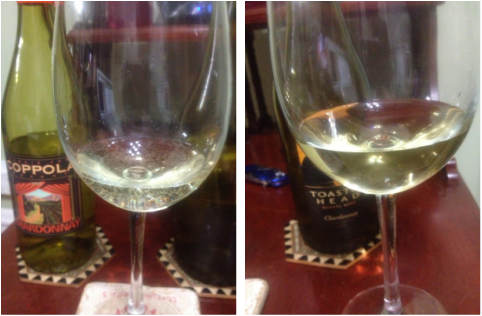
On the left, we have the unoaked Coppola, and on the right, the oaked Toasted Head. Notice the color variance and bubbles.
This is the first of a series of posts in which I will pick some wines for you to taste along with me at home.

For this post, I chose to tackle two chardonnays with the idea of being able to pick out the nuances that oak imparts.  I wanted to work with wines I thought would be readily available in most parts of the country and that didn’t cost a lot of money. I got both at my local grocery store.

We’ll start with an unoaked 2009 Coppola Vineyards Chardonnay. I paid $8.99 for it on sale (normally it’s about $10.99.) It has a bright yellow color and actually has lots of teeny bubbles that cling to the inside of the glass. It has a fruity nose. Sort of a tropically pineapple smell. The first sip is lemony tart with a sort of stone fruit flavor following it. I get peaches. It is well balanced and unoffensive. Nothing really to write home about. It’d be nice on a summer evening, but you can probably find something comparably refreshing with a little more going on. The only memorable thing about it really is its tart, subtly fruity flavor. Meh.

The oaked chardonnay is a 2011 Toasted Head. I paid $9.99 for it, but it is normally $14.99. Its color is a little more goldeny yellow than the Coppola, but it is much clearer and brighter. It has a very, very fruity, sweet aroma. Surprisingly complex- it borders on floral and almost reminds me of a Riesling. It has caramel and vanilla notes as well. It smells pretty oaky. Almost like brown liquor (something I am fond of.)
Its flavor is not sweet (the nose is deceptive) and it has everything that the Coppola had in terms of fruitiness and acid balance, but with much more spicy complexity imparted by the oak. It has a toasty, caramel, almost burnt sugar taste that lingers after swallowing.

I personally don’t always love oaked chardonnay, because it can be too buttery (a stylistic flavor imparted by bacteria, actually...) It isn’t my favorite white wine, as a rule. I had a Sonoma chard last year that was bordering on grassy and tasted like asparagus. Not my thing. However, this one has changed my mind a bit! Anyone who isn’t a big fan of oak won’t like this Toasted Head, as it is pretty strongly oaked (it makes me wonder if they used new oak, or lots of oak dust or chips in processing.) However, if you like brown liquor or enjoy a little spice, you’ll likely enjoy this wine. I think it’d be great with food or alone. If you find it on sale like I did, it’d be worth getting a few bottles to sock away (I’ll be looking out for it.)


These flavors are hard to accurately describe without you tasting them yourselves, so go forth! Taste along and feel free to put your thoughts in the comments!

Did you know?
Chardonnay is one of the most widely planted grape varieties in the world. It is pretty easygoing in terms of viticulture and will grow in many different climates. It is also easily adaptable to a variety of winemaking styles. Consequently, it is hard to pin down just what a chardonnay “should” taste like. You’ll just have to get adventurous and try a bunch! 

2 Comments

No Kick from Champagne? Maybe You Just Need the Right Glassware… 

3/27/2013

2 Comments

 
There's really no reason for sparkling wines to only be special occasion wines. They're good year-round, alone or with food. And, I don’t know if you’re like me, but I’ve always dreamed of owning a set of those glamorous, old fashioned champagne saucers. You know the ones... The impeccably dressed and styled drinkers are sipping out of them while listening to Cole Porter and gazing out over the black and white 1930s Manhattan skyline… Legend has it that their shape was inspired by a mold of Marie Antoinette’s breast (saucy!)

My storage space is limited, so I’ve never been able to justify buying champagne glasses of any kind. But one day, I got curious. Why don’t you see many of the saucer style glasses nowadays? Why the ever-present flute (tulip or trumpet) shape we’ve all come to know?


I'm not really sure where the preference shifted, it seems to be sometime in the 1960's or 70's (if my online vintage shopping tells me anything.) But, it really does make perfect sense- favoring the flute is a matter of function. The saucers just aren’t a good shape for sparkling wine. All those tiny little bubbles are just dying to rush to the top and make their bid for freedom. The giant bowl of the champagne saucer gives them lots and lots of surface area to make their escape. Whereas, the long narrow shape of the flutes gives them more opportunity to hide out and cling to the bottom of the glass, with far less area to break at the surface. Pretty straightforward.

So, unless you plan on throwing the entire thing back nice and quick (I'm not judging,) your champagne toasts are much better served in our modern flute. However, if you’re in the mood to throw a Casablanca-themed party one of these days, these plastic versions could be a fun, low-commitment substitute (though I should inject that my depression-era grandmother would insist that you wash and re-use them. )
Go right ahead! Play it, Sam!

Did you know?
Sparkling wines today are made in two basic ways. According to the traditional method, the wines undergo a secondary fermentation (in tank or bottle-it varies from region to region) in which the carbonation is not allowed to escape. I'm over simplifying, as it is actually a pretty complex process, but you get the drift. The more modern and sort of “quickie” method is done by the same process by which we carbonate our soda. Yep. Basically, they pull a Sodastream maneuver and inject carbon dioxide into the wine.
You can tell the difference when you pour them in your glass. The traditionally made wines have delicate, tiny little bubbles. Whereas the soda-style sparklers have large, splashy bubbles. If you had one of each side-by-side, it’d be obvious.

2 Comments

The Clues are in the Color

3/6/2013

0 Comments

 
I mentioned in a previous post that you can tell a lot about a wine by its color. This is particularly true when evaluating a wine’s age. Once you know what colors are typical of wines at certain stages in their aging process, it can be fun to play detective and check colors for yourself.  (Of course, the lazy route is to just look at the label, but this is a fun way to test yourself- and can actually give you a heads-up if something like oxidation is wrong with your wine.)

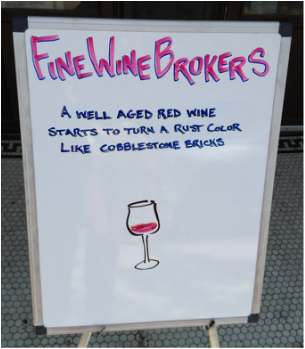
As a fun intro note, I was walking by Fine Wine Brokers in Chicago last year, and at the exact time I was studying wine color in class, they had this sign out front. Serendipitous! 

Picture
Anyhow. Onto the info:
White wines will range in color from anywhere from a yellowy green to a yellowy brown color. I’d say most white wines you find on your grocery store shelf will be somewhere close to the color of pale straw (deeper to paler, depending on varietal, oak usage, and other winemaking techniques.) Very young white wines will have a more greenish tinge, whereas older whites will darken in color, with some dessert wines and Madeiras having a true brown color (Madeiras undergo a heating process that essentially bakes them.)

Here’s sort of a visual of the range of white wine colors you can expect (though remember these colors are definitely more saturated and exaggerated than what you’d find in your glass.)

Picture
Generally, wines that are 1-3 years old will be in the light yellow range (with younger being greener.) Dry white table wines 5+ years old will deepen into a gold or brown color. But as a general rule, this isn't what you want to see in your glass. Don’t let your white wines get that old. Drink ‘em!

Dessert and sweet wines will have a gold color and this is fine.  They can age 5+ years without necessarily passing their peak. Some can age 20+ years!

If  you open a young bottle of white wine and it looks brown, this could mean it got accidentally baked in transit somewhere- likely in a hot vehicle… Oops.

Red wines similarly have a varying range of color based on age. The more purple the wine, the younger it is. Reds that are less than 2 years old will often have this purpley hue. From about 2-4 years old, the wine will take on a nice dark ruby red color. This is the sign of a mature wine. Good and drinkable! The majority of the wine you find on the grocery store shelf is best consumed in this window. (Again, remember that there is room for variance here depending on varietal, so this is a generalization.)

Older wines will take on a brick red or reddish brown appearance, as our friends at the wine shop pointed out above. For many fine wines, this 5-10 year window of brick red coloring is ideal. And for a very select few (those rarities that sell for small fortunes at auction,) they may even take on a deep, rich, fully brown color.

Again, my color chart here is exaggerated, but gives you an idea of the range.

Picture
In order to best evaluate the color of a wine, it is best to have neutral overhead lighting and to hold a plain white piece of paper behind your wine glass. Tip the glass to about a 70 degree angle (don’t slosh!) and look at the color nearest the top edge of the wine. What color is it? (And remember, everyone perceives color differently, so there’s no 100% right answer.)

Now, go forth! Impress your friends with your super-sleuth skills!


Did you know?
In blind tastings, wines are often presented under dim lighting in black glasses. This is because judges can sometimes make accidental educated assumptions about a wine based on its color, before they even take a sip... Sneaky! 

0 Comments

Accessorize! 

2/20/2013

2 Comments

 
There are lots of wine accessories on the market. I obviously haven’t tried them all, but I do have opinions on a few.

1.     Decanters.
I have one. I almost never use it. If I were drinking lots of aged red wines, or unfiltered wines with lots of sediment, it’d probably be getting more use. Also, I’m seldom pouring out a whole bottle at once. That said, they are pretty and would work well at dinner parties.

2.     Openers (there are lots of different kinds of openers. I’ve tried many. And I have strong feelings on which is the best.) It's a little bit of a Goldilocks situation.
            a.     The winged variety of corkscrew.  Frankly, I hate these (no offense to this particular brand- I just hate them in general.) They suck. In my experience, about 8 times out of 10, they just destroy the cork. If I’m successful in getting it out, it inevitably leaves little bits floating in my bottle. No thanks. We can do better.
            b.     The Rabbit.  I was super excited to get one of these. I assumed it would streamline my life. Sadly, it did not. It does a good job about 70% of the time, but the other 30% has been sort of disastrous. Once, it pushed the cork in, only about halfway. I was able to stop it going all the way in, but as it pulled the cork back up, it also drew red wine up around the sides, thereby spraying my dining room in a shower of red droplets. For the price, I don’t’ think you really get the most bang for your buck- so to speak.
           c.      The waiter-style corkscrew. This one is my favorite. It is cheap, easy to use, and almost never fails me. It may take a little bit of practice to get down pat, but once you do, I think you’ll never go back. I do like the double hinged variety. It allows for more sort of "ratcheting" control. And most come with a built in blade for cutting foil.
           d.     The weird two pronged variety of opener. I’ve never used one and am scared to try. In the words of Lucille Bluth, “I don’t understand the question, and I won’t respond to it.”

3.     Aerators.
I have the Vinturi. I really like it. I wouldn’t have bought it for myself (it was a delightful Christmas gift a few years ago.). But I love having one and have since purchased quite a few of them as gifts. They do everything a decanter does and are much more versatile. You can pour one or two glasses at a time, take it on a picnic, wash it easily... If you're choosing a product that will remove sediment and let oxygen into your wine, skip the decanter. This is the way to go. (They also make a model specific to aerating spirits. I haven't used it, but have heard good things.)

4.     Chillers. (For those of you who don't want to live on the edge by throwing a bottle in the freezer and setting a timer like I do...)
          The only one I've personally tried is your classic marble chiller- good for keeping things cool. I have friends who own one and we often bust it out when drinking white wines at their place. It does a good job. 

           If you're curious about investigating other types, there are several out there on the market. They range from low to high tech.


5.     Wine charms. These are frivolous and unnecessary, for sure. However, they’re fun. If you plan to entertain frequently and want to help your guests remember whose glass is whose, they’re a fun little item to own. There are several variations on the theme. I personally find the stick-on mustaches quite delightful, though the ones I own are a little more conventional- but hand made!


6.     And, the best of all, the Vacuum Wine Saver. This thing is THE ONE. Lots of you probably have one, but if you don't, get one now. You can keep wine fresh for a long time with these suckas. Especially in the fridge. 

Do you have any favorite wine accessories? Disagree with any of my opinions? Have you uncovered the surprising genius that is the two-pronged opener? Feel free to share in the comments.

UPDATE: My awesome friend, Kevin (hopefully he'll be guest-posting soon,) informs me that the two-pronged wine openers DO serve a purpose.
In a wine where the cork has become degraded, a regular corkscrew will just shred it and you'll wind up with giant chunks of cork in your bottle. Soooo, those two prongs are meant to slip in around the outside of the wonky cork and gently wiggle it up out of the bottle. He's never had to use one, but that's theoretically what they are for.
 Learning!

UPDATE 2: This comment comes from one of my amazing classmates, Dave Specter of Bells Up Winery. "One small thing. I love the vacuum sealers and they do their job well. But even with the sealers, wine can pick up odors from your fridge from stronger smelling foods. It also happens with unopened bottles, which is why I don't advise leaving a bottle in the fridge for terribly long - opened or not." Good advice, Dave! 

Did you know?
A great way to keep red wine from staining is to immediately cover the spill with baking soda. Then you can rinse it out, or vacuum it off and then spot clean with water, depending on the location of the spill. Seriously. I accidentally sloshed on someone’s couch one time. Baking soda right away meant there wasn’t a trace of the stain left! It was miraculous. 

2 Comments

Tasting is Hard!

2/17/2013

0 Comments

 
Wine tasting can be hard! Well, obviously tasting isn't hard- you just put the wine in your mouth and your tastebuds (and your nose!) go to work. But putting your finger on what exactly it is you’re tasting in a glass of wine can be tricky. Really, it takes practice. 

The tricky thing about taste is that just like with colors, people perceive flavors differently. I ran into this experience in class where everyone but me had identified something as “honeydew” but to me, it was clearly a more floral note like “jasmine.”
Nothing melony about it.

That said, I do find it really useful to have a list of flavors- it helps me to really pinpoint what it is I think I’m tasting or smelling.

Dr. Ann Noble at UC Davis is credited with creating the Wine Aroma Wheel. You can buy one here.
They’re visually pleasing, sturdy, and easy to follow (you start in the center and work your way out.) But if you don’t want to buy one, there are some knockoff versions available through a basic google search (though buying one is the forthright thing to do.) Or, you can also just sort of think of things by category.

I’ll list the categories I find most useful below (note that my categories don’t exactly line up with the ones on the aroma wheel, but it’s a similar idea.) I’ve tried to color code them by white or red wine. Red wine descriptors are in red, and white wine descriptors are in green. If something could easily apply to both, they'll be brown. This is not to say that any of these flavors couldn't be present in either type, it's just going to be more common in the ones I've colored here. Some of you may disagree with my categories, which is OK by me. You may also someday detect something that I haven't included here- good job!

Fruity
            Fresh                                                                   Dried
            Blackberry                                                          Fig
            Cherry                                                                 Raisin
            Strawberry
            Raspberry
            Currant
            Apple
            Apricot
            Peach
            Grapefruit
            Lemon
            Lime
            Lychee
            Guava
            Pineapple               
Nutty
            Almond
            Walnut
            Hazelnut
Spicy/ Toasted
            Anise
            Clove
            Pepper
            Cinnamon
            Tobacco
            Vanilla
            Caramel
           Coffee
            Chocolate
            Toast
            Leather
Vegetal (some of these are desirable. Some aren't.)
            Green Beans
            Bell Pepper
            Grass
            Olive
Floral
            Honeysuckle
            Jasmine
            Tulip
            Violet
            Orange Blossom
            Rose
Woody
            Oak
            Pine
            Cedar
Mineral
            Chalk
            Limestone
Fungal
           Truffle
            Mushroom
Other
            Butter
           Honey
           Cheese

Read More
0 Comments

Your Mission, Should You Choose to Accept...

2/16/2013

3 Comments

 
Picture
We clearly felt passionate about Chilean wines that night...
By far, the most fun (and voluntary!) homework assignment given me from Washington State University was to start a wine tasting group with my friends. One of my favorite Enology professors (holla Jim!) told us of an assignment he was given as a grad student: in order to figure out where you want your wines to stand on a global scale, start a monthly tasting group where each month you select a different region of the world. My Chicago group has been going for well over a year and we've all learned a ton!

So, if you’d like to start one of your own, your assignment is as follows:

- Select a group of friends (any size will do- ours fluctuates from about 6-12 people) who are interested in learning about wine and not afraid to nerd it up.

- Each month, or every other month, or quarterly (whatever works best for your schedules,) a different person or couple will choose a region of the world. They will study this region and create a presentation for the rest of the group (we use Powerpoint- no joke.) It should cover things like – what are the typical characteristics of wines from this region? Why are they like this?  Are there any famous wines from this region? etc. 
The fun part is that the hosts purchase a selection of wines from this region for people to taste. The cost of the bottles should be split evenly amongst the group. This means it stays relatively fair from host to host. A tip I'm going to suggest is for everyone to take notes on each wine as they're poured (it is impossible to remember them all when you get home.) This is something this month's hostess did, and I wish we'd started it from square one!

-Each host (or any member really) should feel free to invite new members to the group- the more people you have, the larger variety of wines you can taste! Plus, it is a great way to make new friends! We’ve had people come and stay on as regulars, or come every few months when they are able. It’s been great.

Our group has evolved into the non-hosting members bringing a little snack to share- though I’m a stickler, and when I host, I encourage people to wait to eat till after they’ve tasted a little of each wine- keep those tastebuds pure (with the exception of bland crackers.) But there've been some yummy treats!

After almost a year and a half, we’re starting to feel as if we might run out of regions, so now will also be moving to comparing varietals- such as, "let’s see what the differences are between Cabernet Sauvignons from California, Australia, Chile, France, etc." I'm also hoping to do one on boxed wines. 

So far, we've done the following: Bordeaux, California, Argentina, Chile, Germany, Sparkling, Sake, Portugal, South Africa, Australia, Spain, and Italy (I hope I'm not forgetting any- hopefully my group members will comment if I am!)

This group has taught me a lot about pinpointing what characteristics are common to specific varietals (and contrastingly, which characteristics are flipped totally on end from region to region,) what I like and don’t like, and just how much climate and location really can impact a finished wine! It is also a great way to find new wines you like and would want to buy 
again. There's usually a keeper or two at each meeting.

Go forth! Have fun! Drink responsibly!

(A little tip to the hosts- ask people to pay up before they start tasting- things usually get a little too fun and people often forget till the next day.)

Oh, and for scheduling, we use Doodle. It’s very useful!


Picture
Just a few of our awesome regular attendees. I had more pics, but they were blurry... my photo skillz do not improve with wine.
Did you know? 
Australian and German Rieslings taste nothing alike. I was never a big fan of Riesling, but the only ones I’d really had were either German or German style sweet or off-dry wines. While hosting the Australia night, I discovered that their Rieslings are often very tart with citrus notes- not sweet at all, and just what I like in a nice, food friendly, white wine. The more you learn...

3 Comments

Glassware: form = function

2/8/2013

4 Comments

 
This post topic was suggested by Stacey- she wanted to know if glass size and shape were actually important and if so, why?

Well, the short answer is: Yes. They are important. Now, I’m going to preface this by saying that if you don’t have the ideal glassware, but you have a bottle of wine that wants drinkin’, use what you’ve got! Juice glass, solo cup, whatever.

However, if you do want to… “maximize your wine experience” we’ll say, then the proper glassware can help.

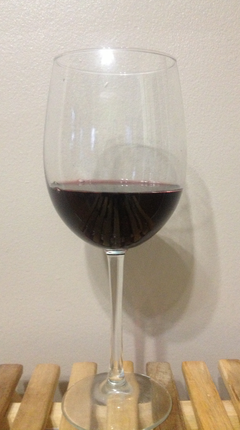
The ideal wine glass is what they call "tulip" shaped and made from clear glass (you can tell a lot about a wine by its color- something I'll go into in another post- and colored glass would mask those clues.) It has a big full bowl and narrows slightly as it goes up toward the rim. You know what it looks like. It looks like this: 

Picture
The reason its shape is considered ideal is that the round bowl allows you to swirl the wine around (there IS a good reason people swirl wine in the glass- it isn't just to look pretentious,) unlocking aroma compounds, which are then trapped a little in the air inside the glass until you can take a little sniff and sip. You actually have two pathways for smelling- your nose (obviously) and also receptors in the back of your throat that you use when you take a drink. So getting those aroma compounds to come out of the wine, but stay trapped in your glass till you can get it up to your nose or mouth will maximize all that this amazingly complex stuff has to offer.

One of these days I’ll go into aroma compounds a little bit more in-depth because they’re pretty nifty. But for now, all you need to know is that some are quick to escape from the wine, and some take a little longer. This is why it is smart to re-cork or vacuum seal a bottle of wine right away if you don’t plan to drink it all in one sitting. It’s also why a glass of wine can continue to change in aroma and taste as it is exposed to oxygen and “breathes.”

(As a general rule, red wines tend to have more complex aroma components and therefore do well to “open up” a little and let those aroma compounds unlock from the wine before drinking.)

Now, there’s also another question when it comes to glassware- stemless or stemmed?

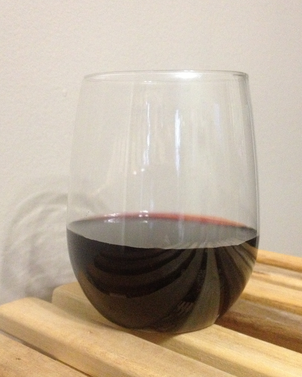
Stemless glasses like this one are pretty trendy right now. 

Picture
They do have the correct shape for swirling and trapping aroma compounds. However, I personally only recommend stemless glasses for red wines. This is pretty simple- red wines are supposed to be served warmer than whites, which are best served fresh out of the fridge. (As a side note, the "room temperature" recommended for red wines was established before we all had central heating. They actually should be served a little cooler than modern room temp.)

Ok, back to glassware- A stemless glass will absorb heat from your hand, and therefore it really isn't good for retaining that nice crisp temperature for whites. Also, with a cold white wine, they’re more likely to sweat and make a ring on the bottom- if you care about such things. Ultimately, It’s really a matter of preference.  

I like a nice medium to large glass with a stem- and it needs to be sturdy. I got mine for cheap at Pier One- they get broken, it happens, and this way, they're easily replaceable and I- or my guests- don't feel too bad.

Cheers!


Did you know?
When you detect something like blackberry or lychee in a glass of wine, that’s because you are tasting or smelling the same molecular compounds that are present in those fruits!  

4 Comments
Forward>>
    Wanna receive updates in your inbox?
    Enter your Email:
    Preview | Powered by FeedBlitz

    Author

    I'm a wine-loving actress in the Windy City who holds certificates in Enology and Viticulture from Washington State University. I also own a hilarious cat.

    Archives

    October 2014
    September 2014
    August 2014
    April 2014
    March 2014
    February 2014
    January 2014
    December 2013
    November 2013
    October 2013
    September 2013
    August 2013
    July 2013
    June 2013
    May 2013
    April 2013
    March 2013
    February 2013
    January 2013

    Categories

    All
    101 The Basics
    Alcohol Content
    Grape Growing
    Media/Pop Culture
    Pests And Diseases
    Sugars
    Tasting
    Vocab
    Wine Making

    RSS Feed